
Choosing between hard-boiled eggs and 2% cottage cheese shapes your cardiovascular health in surprisingly divergent ways. While eggs deliver concentrated micronutrients alongside dietary cholesterol, cottage cheese provides rich protein with substantial sodium.
Your optimal morning choice depends on whether your personal heart strategy focuses on blood lipid management or blood pressure control. Both foods support metabolic health while offering distinct clinical tradeoffs.
Understanding how saturated fat, dietary cholesterol, and sodium interact helps you build a heart-protective breakfast without sacrificing morning convenience.
Nutritional Breakdown: Comparing the Heart Markers
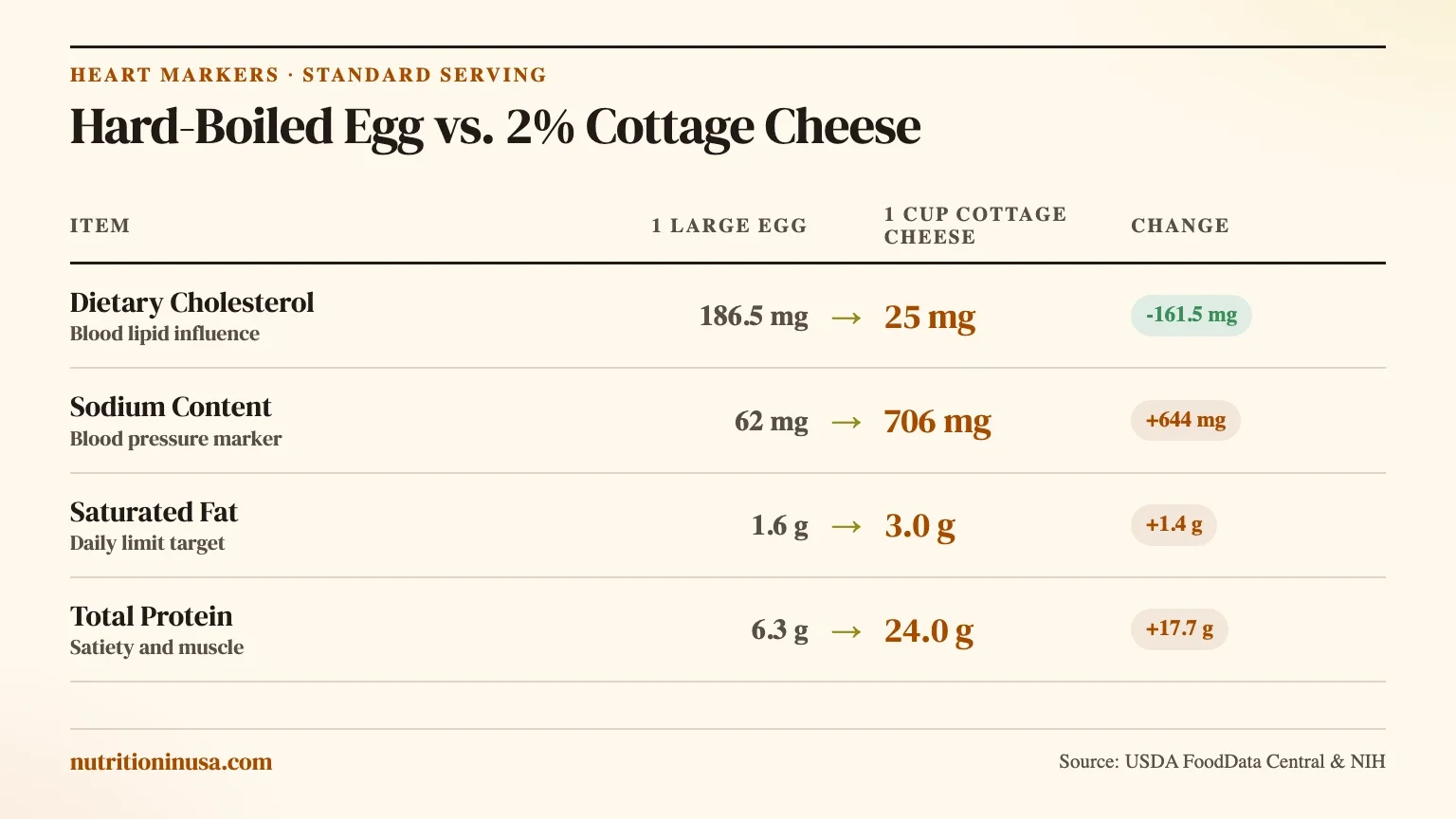
A standard serving tells two distinct nutritional stories. One large hard-boiled egg provides 78 calories, 6.3 grams of protein, and 1.6 grams of saturated fat.
That same egg contains 186.5 milligrams of dietary cholesterol alongside a modest 62 milligrams of sodium, according to the USDA FoodData Central database.
In contrast, a one-cup serving of 2% cottage cheese delivers 185 calories, 24 grams of protein, and 3 grams of saturated fat.
While cottage cheese contains only 25 milligrams of cholesterol per cup, it packs 706 milligrams of sodium—nearly 31 percent of your recommended daily limit.
If you prefer a half-cup portion, 2% cottage cheese provides 92 calories, 11.8 grams of protein, 1.4 grams of saturated fat, and 348 milligrams of sodium.
Eggs also dominate in choline content, providing 147 milligrams per large egg—roughly 27 percent of your daily value.
By comparison, a full cup of 2% cottage cheese contains only about 36 milligrams of choline, as outlined by the National Institutes of Health choline fact sheet.
Science Snapshot: How Each Food Influences Your Arteries
Cardiovascular researchers historically blamed dietary cholesterol for driving up serum LDL cholesterol levels. Contemporary research proves that saturated fatty acids exert a far stronger influence on blood cholesterol synthesis.
The 2026 ACC/AHA Dyslipidemia Guideline emphasizes that limiting saturated fat lowers LDL cholesterol far more predictably than simply restricting dietary cholesterol intake.
For most healthy individuals, the cholesterol in eggs causes minimal elevation in circulating LDL particles. Your liver compensates by producing less endogenous cholesterol when dietary intake rises.
An American Heart Association science advisory affirms that healthy adults can safely eat up to one whole egg daily.
The advisory also confirms that healthy older adults with normal lipid panels can consume up to two eggs per day without adverse cardiovascular consequences.
However, cottage cheese introduces a separate vascular concern: fluid retention and arterial stiffness driven by elevated sodium.
Consuming 706 milligrams of sodium in a single breakfast cup pushes you rapidly toward the American Heart Association ideal ceiling of 1,500 milligrams per day.

Evolving Standards: The FDA Healthy Rule and Changing Guidelines
Federal nutrition policies have updated how agencies evaluate these two popular breakfast staples. In recent years, regulators realigned definitions to match modern lipid science.
Under the Food and Drug Administration updated healthy claim criteria, whole eggs qualify as healthy because the agency removed legacy restrictions on dietary cholesterol.
Yet standard 2% cottage cheese struggles to qualify under that same rule due to its sodium concentration.
The rule mandates that dairy foods stay at or below 230 milligrams of sodium per serving, which conventional cottage cheese easily exceeds.
Meanwhile, the Dietary Guidelines for Americans raised baseline protein targets to 1.2 to 1.6 grams per kilogram of body weight daily.
This guideline update explains why both foods remain wildly popular among adults aiming to preserve lean muscle tissue as they age.
Three Strategic Pillars for Your Breakfast Routine
Pillar 1: Balance Saturated Fat Budgets
The American Heart Association recommends capping saturated fat intake at less than six percent of your daily caloric intake. On a 2,000-calorie pattern, that translates to approximately 13 grams per day.
Two hard-boiled eggs supply 3.3 grams of saturated fat, leaving ample room for heart-healthy mono- and polyunsaturated fats throughout the afternoon.
A full cup of 2% cottage cheese delivers roughly 3 grams of saturated fat. If you pair it with whole milk or buttered toast, you quickly exhaust your daily limit.
Pillar 2: Manage Sodium and Potassium Equilibrium
High sodium intake constricts blood vessels and drives up systemic blood pressure over time. You can neutralize cottage cheese’s sodium load by pairing it with potassium-rich additions.
Add sliced strawberries, blueberries, or fresh melon to your cottage cheese bowl to boost mineral balance. The natural potassium in fruit blunts the blood-pressure impact of dietary sodium.
If you prefer eggs, prepare them without table salt and season them with smoked paprika, turmeric, or cracked black pepper instead.
Pillar 3: Optimize Protein and Micronutrient Timing
Protein distribution across morning meals prevents mid-day glucose spikes and supports arterial endothelial health. Cottage cheese provides exceptional leucine density for muscular synthesis.
Eggs offer specialized fat-soluble nutrients that dairy products lack, including lutein, zeaxanthin, and bioavailable vitamin D. Alternating both foods during the week gives your cardiovascular system comprehensive biochemical support.
Clinical Perspectives: What Practitioners See in Practice
Preventive cardiologists frequently remind patients that dietary context matters far more than isolated food items. Your overall eating pattern dictates your arterial health.
Dr. Elena Ramos, a preventive cardiologist, notes that an egg eaten alongside spinach and avocado behaves differently in the body than an egg fried in sausage grease.
She observes that patients who swap refined breakfast pastries for hard-boiled eggs routinely experience improved insulin sensitivity and lower systemic inflammation.
Registered dietitians emphasize portion adjustments when working with budget-conscious older adults. Cottage cheese offers convenient, no-cook protein, but serving size control remains vital.
Dietitian Marcus Vance advises his hypertensive clients to measure half-cup portions of cottage cheese or seek out no-salt-added varieties at the supermarket.

Safety Considerations and Personalized Adjustments
Not every body responds identically to dietary cholesterol or dairy proteins. Individual metabolic variations require a personalized nutritional approach.
Roughly 25 percent of the population qualifies as cholesterol hyper-responders. In these individuals, dietary cholesterol causes a pronounced spike in circulating LDL-C and ApoB particles.
If you carry a diagnosis of familial hypercholesterolemia or type 2 diabetes, discuss your weekly egg intake with your healthcare provider.
Individuals managing chronic kidney disease must monitor the phosphorus and concentrated dairy protein found in cottage cheese.
Those with lactose sensitivity or cow milk protein allergies should stick with eggs or explore plant-based calcium alternatives.
Frequently Asked Questions
Can I eat hard-boiled eggs every day if I have high cholesterol?
If your LDL cholesterol is elevated, medical guidelines advise moderation with dietary cholesterol sources. Consult your physician, as limiting whole eggs to three or four per week may be prudent.
Is low-sodium cottage cheese as nutritious as standard 2% cottage cheese?
Yes, no-salt-added cottage cheese preserves identical protein and calcium levels without the cardiovascular strain of excess sodium. It represents an ideal choice for anyone managing hypertension.
Which option keeps you fuller throughout the morning?
A one-cup portion of 2% cottage cheese provides 24 grams of protein, delivering superior prolonged satiety compared to a single egg. Eating two eggs with fibrous vegetables produces comparable hunger control.
Do egg whites offer a heart-healthier alternative to whole eggs?
Egg whites provide pure protein with zero saturated fat and zero cholesterol. However, discarding the yolk eliminates nearly all the egg’s choline, vitamin D, and antioxidant carotenoids.
Your Next Step: A 24-Hour Heart-Healthy Action Plan
Evaluate your breakfast routine tomorrow morning through the lens of your specific cardiovascular risk factors. If your blood pressure runs high, choose hard-boiled eggs seasoned with fresh herbs.
If your blood pressure is optimal and you need high protein for physical training, enjoy half a cup of 2% cottage cheese topped with fresh berries.
Take five minutes today to check the nutrition facts on your dairy tubs and plan a heart-smart protein rotation for the coming week.