
If you want a crunchy afternoon snack that will not send your glucose soaring, choose popcorn over pretzels. Popcorn delivers intact whole grains and gut-slowing fiber, whereas traditional pretzels digest almost instantly into simple sugars.
With 115.2 million American adults living with prediabetes, making smart carbohydrate swaps has never been more vital for everyday metabolic health. Understanding how these two popular pantry staples behave in your bloodstream helps you protect your energy and insulin sensitivity.
Let us examine the clinical data behind both crunch-worthy snacks so you can make informed choices for your metabolic wellness.
Why Snack Selection Drives Blood Sugar Control
According to the Centers for Disease Control and Prevention, 40.1 million Americans live with diabetes. Daily snacking habits play an outsized role in shaping your cumulative glucose response and cardiovascular health.
When you consume rapidly digesting carbohydrates, your body releases a rapid surge of insulin to clear glucose from the bloodstream. Over time, these frequent blood sugar spikes can promote insulin resistance and increase chronic inflammation.
The Science Snapshot: Glycemic Index and Fiber
The glycemic index measures how quickly a carbohydrate-containing food raises your blood glucose compared to pure glucose. Foods scoring 55 or lower sit in the low-glycemic zone, while those scoring 70 or higher represent high-glycemic items.
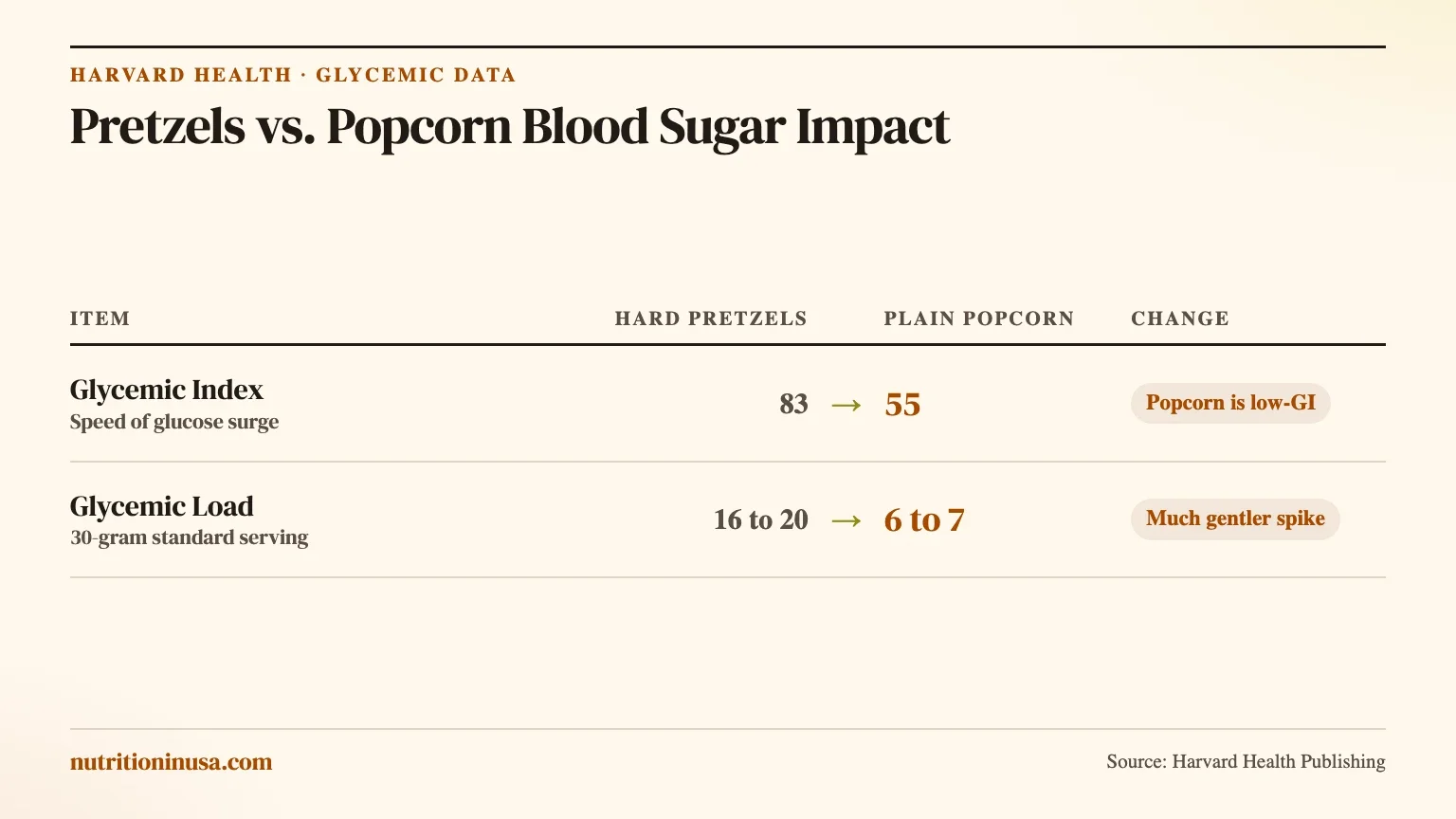
Data compiled by Harvard Health Publishing reveals that oven-baked hard pretzels carry a steep glycemic index of 83. In contrast, plain air-popped popcorn tests at a friendly 55, right on the low-glycemic threshold.
Glycemic load provides additional context by factoring serving sizes into the equation. A 30-gram serving of hard pretzels carries a high glycemic load of 16 to 20; plain popcorn registers a modest glycemic load of 6 to 7.
This dramatic divergence happens because pretzels are crafted from refined wheat flour that lacks natural bran and germ. Popcorn remains a 100% intact whole grain packed with dietary fiber that naturally buffers carbohydrate digestion.
Nutritional Breakdown: Popcorn vs. Hard Pretzels
Serving sizes tell an illuminating nutritional story. Under federal labeling rules, the standard reference amount for both crunchy snack items is 30 grams.
Records from USDA FoodData Central show that a standard 3-cup serving of air-popped popcorn provides roughly 18.7 grams of carbohydrates and 3.5 grams of fiber. This delivers high physical volume that stretches your stomach and enhances fullness.
Conversely, a single ounce of hard salted pretzels provides nearly 23 grams of total carbohydrates but less than one single gram of fiber. Without protective fiber, your digestive enzymes quickly convert those pretzel starches into circulating glucose.
Soft pretzels present an even steeper metabolic challenge for your system. A single medium soft pretzel contains over 80 grams of refined carbohydrates with negligible fiber, which delivers a massive glucose payload.
Under the updated Food and Drug Administration healthy labeling framework, grain products must supply whole grains while limiting sodium and saturated fat. Plain air-popped popcorn qualifies as a nutrient-dense whole grain, whereas refined-flour pretzels fail to meet this benchmark.
Federal dietary surveys show that only 7% of American adults meet the daily fiber target of 28 grams. Selecting popcorn provides valuable roughage that supports gut microbiome health alongside blood sugar stability.

Strategy Pillars for Balanced Snacking
Making strategic snack choices does not require total deprivation. Adopting three practical behavioral habits helps you enjoy satisfying crunch without compromising your glycemic targets.
1. Nutrient Pairing: Never Eat Carbs Naked
You should avoid eating starchy snacks in isolation. Pairing whole-grain popcorn with a handful of raw almonds or pumpkin seeds introduces plant-based proteins and monounsaturated fats.
These macronutrients delay gastric emptying and prevent post-snack glucose surges. If you occasionally indulge in pretzels, dip them in unsweetened peanut butter to blunt the anticipated glycemic rise.
2. Portion Awareness and Volume Management
Because pretzels are calorie-dense and compact, eating past your target portion takes mere minutes. Popcorn occupies considerable visual space, which tricks your brain into feeling thoroughly satisfied on fewer total calories.
Measure your snacks into small bowls before sitting down on the couch or at your desk. Mindful plating breaks automatic hand-to-mouth snacking loops that lead to unintended glucose spikes.
3. Habit Formation: Read the Label Fine Print
The Dietary Guidelines for Americans urge consumers to prioritize whole grains and limit ultra-processed snacks with added sugars. Not all packaged popcorn varieties meet this healthy standard.
Commercial kettle corn can pack 7 grams of added sugar into a small single-ounce serving. Always inspect the ingredient list for hydrogenated oils, excessive sodium, and hidden cane syrups before purchasing.
Prepare portion-controlled snack bags in advance to prevent unconscious grazing straight from oversized retail bags. Keeping single-serving portions on hand removes decision fatigue during demanding workdays.

Expert Perspectives and Clinical Observations
Clinical dietitians observe that patients with prediabetes often struggle during the mid-afternoon slump. Swapping refined crackers or pretzels for air-popped popcorn frequently smooths afternoon continuous glucose monitor tracings.
Patient feedback also highlights improved subjective energy levels. When you eliminate sharp post-snack glucose peaks, you naturally avoid the reactive hypoglycemia crashes that trigger intense sugar cravings.
Continuous glucose monitoring confirms that individuals experience unique glycemic responses to identical foods. Tracking your personal post-meal blood sugar levels empowers you to verify how different preparation styles influence your numbers.
Safety Considerations and Special Populations
While popcorn offers clear metabolic advantages, you should evaluate your individual medical profile before making sudden dietary shifts. Salted hard pretzels deliver roughly 352 milligrams of sodium per ounce, which can aggravate hypertension.
Individuals managing gastrointestinal disorders, such as active diverticulitis flares or severe irritable bowel syndrome, may need to limit insoluble popcorn hulls temporarily. In those specific cases, soft, low-fiber carbohydrates might be clinically indicated.
Child safety represents another essential factor for families. The Centers for Disease Control and Prevention warns that both popcorn and hard pretzels pose serious choking hazards for children under age 4.
Frequently Asked Questions
Are gluten-free pretzels better for your blood sugar?
Most commercial gluten-free pretzels rely on potato starch, cornstarch, or white rice flour. These alternative starches digest exceptionally fast and cause blood sugar spikes similar to traditional wheat varieties.
Does movie theater popcorn affect glucose the same way as air-popped?
Movie theater popcorn provides whole-grain fiber, but concessions stands frequently drench kernels in refined coconut oil and heavy sodium. The excessive saturated fat can provoke delayed insulin resistance hours after snacking.
Can you eat pretzels if you have prediabetes?
You do not need to ban pretzels permanently from your pantry. Enjoy them occasionally in modest portions, and always combine them with fiber-rich hummus or protein-dense string cheese to temper glucose absorption.
What is the healthiest way to prepare popcorn at home?
Pop whole corn kernels in an air popper or in a covered silicone bowl inside your microwave. Mist the popped kernels with extra-virgin olive oil and dust them with nutritional yeast or smoked paprika.
Your Next Step
Take twenty seconds right now to audit your snack cupboard. Toss out refined snacks that cause fatigue, and prepare a three-cup batch of whole-grain popcorn for your next mid-day hunger cue.