You do not need to banish fruit from your kitchen to keep blood sugar steady. Knowing which fruits carry the least natural sugar lets you build meals around fiber and flavor without unexpected glucose swings.
Many people avoid berries or apples out of fear while overlooking hidden sugar bombs in dried snacks and canned syrups. This dietitian-built ranking orders fresh and dried options from lowest to highest sugar so you can shop with confidence.
Use these numbers alongside simple portion routines to support healthy energy, heart wellness, and sustainable weight management every day.
The Fruit and Sugar Gap in American Diets
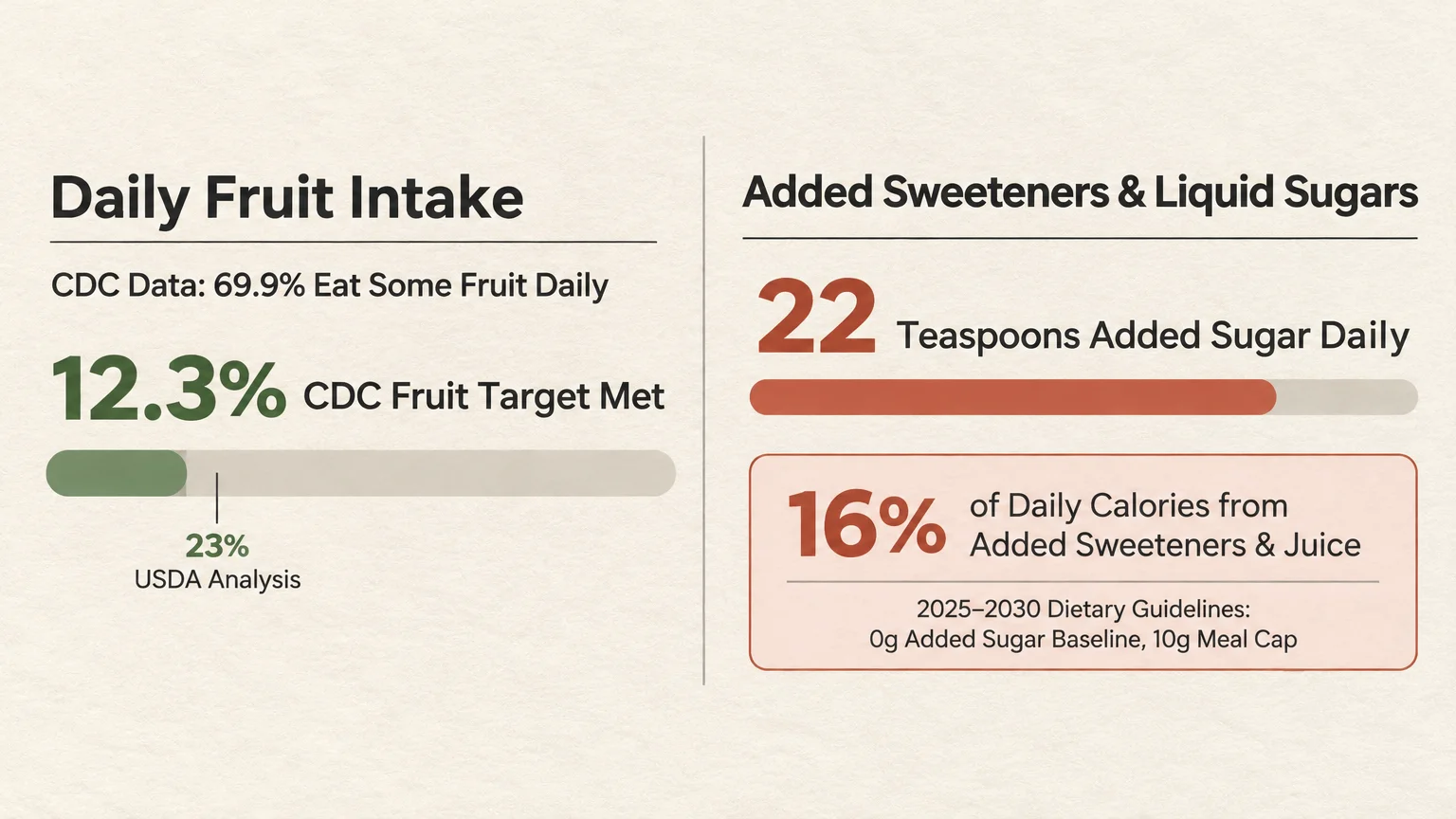
Modern eating patterns often swing between two extremes: too little whole produce and far too much refined sweetener. Data from the Centers for Disease Control and Prevention show that 69.9% of U.S. adults eat fruit on a given day, with women at 73.5% and men at 66.1%.
Yet eating a bite of fruit occasionally is very different from meeting daily nutrition goals. Depending on the survey method, CDC behavioral data estimate that only 12.3% of adults meet daily fruit recommendations, while separate USDA analyses place that figure closer to 23%.
Income also shapes what lands on your plate, with whole fruit intake dropping from 57.3% among higher-income households to 37.2% among adults below 130% of the federal poverty level. Meanwhile, added sweeteners flood the food supply and push daily intake near 22 teaspoons per person.
When you combine added sweeteners with fruit juices, they supply roughly 16% of total daily calories across the country. That overload drives metabolic strain, elevated triglycerides, and sluggish afternoon energy.
To counter that trend, the 2025–2030 Dietary Guidelines for Americans recommend two servings of fruit daily on a 2,000-calorie eating plan. Those federal guidelines clearly state that natural sugar inside whole fruit and plain milk does not count as added sugar.
For added sugars, those same guidelines recommend zero grams as a baseline and cap any single meal at no more than 10 grams. Similarly, the American Heart Association advises limiting added sugars to 6% of daily calories—roughly 25 grams for women and 38 grams for men.
World Health Organization guidance echoes this distinction by advising less than 10% of daily energy from free sugars, and ideally below 5%. Whole fresh fruit stays completely outside that free-sugar limit, whereas fruit juice and juice concentrates count directly toward it.
How Your Body Processes Natural Sugar in Fruit
The Fiber Brake and Sugar Matrix
Every piece of whole fruit packages its natural fructose, glucose, and sucrose inside a cellular wall of water and dietary fiber. When you chew an apple or a handful of blackberries, that physical structure slows stomach emptying and delays sugar absorption in your small intestine.
Instead of hitting your bloodstream in one rapid wave, glucose trickles in gradually alongside vitamins, potassium, and polyphenols. Your pancreas responds with a measured, modest release of insulin rather than an emergency surge.
Fructose travels straight to your liver after digestion rather than raising blood glucose immediately. Inside a whole-fruit matrix, small amounts of fructose process smoothly; in excess liquid form, however, heavy fructose loads can strain liver fat metabolism over time.
Glycemic Index Versus Glycemic Load
To judge how a specific fruit affects your blood sugar, look at both its glycemic index and its glycemic load. The glycemic index ranks carbohydrate foods from 0 to 100, with 0 to 55 considered low, 56 to 69 medium, and 70 or higher labeled high.
Most fresh whole fruits land comfortably in the low-to-medium zone because water and fiber dilute their carbohydrate density. For instance, grapefruit scores a glycemic index of 25, apples sit at 39, oranges at 40, and peaches at 42.
Grapes climb slightly higher into the medium tier at 59, while ripe bananas reach 62. Because glycemic index only measures carbohydrate quality per fixed test amount, glycemic load adds the missing piece by factoring in your actual serving size.
A 120-gram serving of grapefruit carries a glycemic load of just 3, an orange sits at 4, a peach at 5, and an apple at 6. By contrast, a 120-gram portion of grapes reaches 11, and a ripe banana hits 16.
Why Liquid and Dried Fruits Hit Differently
Processing fruit changes its physiological impact even when zero table sugar enters the recipe. Juicing strips away the insoluble fiber scaffolding, leaving behind concentrated liquid sugar that exits your stomach in minutes.
Drinking 100% fruit juice spikes blood sugar far faster than chewing the intact fruit, which explains why federal guidelines urge diluting juice or limiting it strictly. Dehydration creates a different challenge by removing water while packing several pieces of fruit into one small handful.
Dried dates illustrate this gap clearly: their glycemic index sits at a modest 42, yet an 80-gram serving delivers a glycemic load of 18. Without water to fill your stomach, you can easily double your carbohydrate intake before fullness signals register.
Dietitian Fruit Ranking: Lowest Natural Sugar Options
To compare fruits fairly, dietitians evaluate sugar per 100 grams—roughly three and a half ounces—using verified nutrient profiles from USDA FoodData Central. Ranking by equal weight exposes which fruits naturally pack the lightest sugar load per bite.
Tier 1: Ultra-Low Sugar Fruits (Under 2 Grams per 100 Grams)
1. Avocado (0.3 to 0.7 grams sugar per 100 grams): Botanically a single-seeded berry, Hass avocado tops every low-sugar ranking while providing 6.7 to 6.8 grams of fiber per 100 grams. Even a full cup of cubed avocado contains just 1.0 gram of natural sugar.
Because avocados deliver heart-healthy monounsaturated fats alongside minimal carbohydrates, they slow digestion when sliced onto toast or salads. You get creamy richness and lasting fullness without budging your glucose monitor.
2. Lime (about 1.6 grams sugar per 100 grams): One whole raw lime weighing 67 grams contains only 1.1 grams of total sugar. Squeezing fresh lime juice over grilled fish, black beans, or sparkling water brightens flavor with virtually zero glycemic impact.
3. Lemon (about 2.5 grams sugar per 100 grams): A full cup of raw lemon sections provides just 5.3 grams of total sugar, and 100 grams carries only 29 calories. Citrus zest and juice deliver vitamin C and bright acidity that cut reliance on sugary dressings.
Tier 2: Low-Sugar Berries (Under 5 Grams per 100 Grams)
4. Strawberries (4.89 grams sugar per 100 grams): Sweet yet remarkably light on carbohydrates, raw strawberries contain 2.44 grams of fructose, 1.99 grams of glucose, and 0.47 grams of sucrose per 100 grams. That same portion adds 2.0 grams of fiber at just 32 calories.
Because strawberries hold so much water, a generous bowl feels indulgent while staying friendly for insulin sensitivity. Slice them over plain Greek yogurt or cottage cheese for a balanced breakfast.
5. Blackberries (4.9 grams sugar per 100 grams): Blackberries edge slightly past strawberries in fiber density, delivering 5.3 grams of fiber alongside 4.9 grams of sugar per 100 grams. One full cup supplies 7.0 grams of sugar and an impressive 7.6 grams of fiber.
6. Raspberries (low sugar with highest berry fiber): Alongside blackberries and strawberries, raspberries typically provide just 1 to 7 grams of sugar per standard serving while leading common fruits in fiber. Every 100 grams delivers 6.5 grams of fiber, reaching 8.0 grams per cup.
That single cup covers roughly 29% of the 28-gram Daily Value for dietary fiber. Toss frozen raspberries into oatmeal or blend them into protein smoothies to tame morning glucose spikes.
Tier 3: Refreshing Everyday Picks (6 to 8 Grams per 100 Grams)
7. Watermelon (6.2 grams sugar per 100 grams): Despite its crisp sweetness, watermelon ranks surprisingly low in sugar by weight and provides just 30 calories per 100 grams. Because it contains only 0.4 grams of fiber per 100 grams, keep portions moderate and pair it with nuts or feta cheese.
8. Grapefruit (7.0 grams sugar per 100 grams): Tart, juicy grapefruit provides 32 calories per 100 grams and pairs bright citrus aroma with steady morning blood sugar. Always verify with your pharmacist before adding grapefruit if you take daily prescription medications, as certain drugs interact with citrus compounds.
Dietitian Fruit Ranking: Moderate to Highest Natural Sugar Options
Moderate- and high-sugar fruits still belong in a nourishing eating pattern because they deliver potassium, folate, and protective plant pigments. The difference lies in respecting portion sizes and pairing these sweeter choices with protein or healthy fats.
Moderate-Sugar Staples (9 to 13 Grams per 100 Grams)
9. Apricots (9.2 grams sugar per 100 grams): Velvety fresh apricots offer natural sweetness without overwhelming your carbohydrate budget. Two small apricots weighing 70 grams supply just 6.5 grams of total sugar.
10. Oranges (9.3 grams sugar per 100 grams): Whole oranges beat orange juice every time because the white pith and membranes slow down sugar release. Eating a peeled whole orange preserves fiber that juicers leave behind in the strainer.
11. Blueberries (10 grams sugar per 100 grams): Packed with anthocyanins, blueberries hold slightly more natural sugar than blackberries or raspberries. One cup gives you 15.0 grams of sugar paired with 3.6 grams of dietary fiber.
12. Apples (10 to 10.4 grams sugar per 100 grams): Apples offer crisp crunch and pectin fiber, yet size matters enormously at the grocery store. One medium apple weighing 182 grams carries 19.0 grams of sugar and 4.4 grams of fiber, while oversized varieties pack noticeably more.
13. Bananas (12.23 grams sugar per 100 grams): A medium banana weighing 118 grams delivers 14.0 grams of sugar and 3.1 grams of fiber. Choosing slightly underripe bananas with green tips increases resistant starch, which blunts your post-snack glucose rise.
14. Sweet Cherries (13 grams sugar per 100 grams): Sweet cherries combine rich flavor with 2.1 grams of fiber per 100 grams. Measure a small bowl before sitting down rather than snacking straight from a large bag.
High-Sugar Fresh and Tropical Fruits (13.7 to 38.8 Grams per 100 Grams)
15. Mango and Pomegranate (13.7 grams sugar per 100 grams): Both tropical mango and ruby-red pomegranate arils sit at the same sugar concentration per weight. One cup of sliced mango reaches roughly 22.5 grams of sugar, and eating an entire mango delivers around 45 grams.
16. Lychee (15.2 grams sugar per 100 grams): Delicate floral lychees taste light, yet their sugar content climbs quickly when you peel several at once. One cup approaches 29 grams of natural sugar, making small six-to-eight-piece portions a smart boundary.
17. Seedless Grapes (15.48 grams sugar per 100 grams): Red and green seedless grapes provide only 0.9 grams of fiber per 100 grams, which makes them easy to overeat by the handful. One cup holds 23.4 grams of sugar, so freezing individual portions helps slow your pace.
18. Fresh Figs (16.26 grams sugar per 100 grams): Soft and honey-like, fresh figs balance high sugar with 2.9 grams of fiber per 100 grams. One large fresh fig delivers 10.4 grams of sugar, making one or two figs a satisfying cheese-board accent.
19. Jackfruit, Mamey Sapote, and Tamarind (19.1 to 38.8 grams sugar per 100 grams): Among fresh and pulpy tropical fruits, jackfruit sits at 19.1 grams, mamey sapote reaches 20.1 grams, and tamarind tops the fresh scale at 38.8 grams per 100 grams.
Treat dense tropical pulp as a modest condiment or shared dessert rather than a solo snack.
Concentrated Dried and Syrup-Packed Fruits
20. Dried Figs (47.92 grams sugar per 100 grams): Removing moisture concentrates natural glucose and fructose while boosting fiber to 9.8 grams per 100 grams. One single dried fig contains 4.0 grams of sugar, whereas a full cup skyrockets to 71.4 grams.
21. Zante Currants (62.3 grams sugar per 100 grams): Tiny dried currants pack dense carbohydrate energy into baked goods and grain salads. A standard 40-gram quarter-cup serving provides 24.9 grams of sugar.
22. Dark Seedless Raisins (65 grams sugar per 100 grams): Raisins deliver 4.5 grams of fiber and 299 calories per 100 grams, turning two tablespoons into a potent pre-workout fuel. Keep portions strictly measured when blood sugar management is your priority.
23. Pitted Medjool Dates (66 grams sugar per 100 grams): Caramel-rich Medjool dates provide 6.7 grams of fiber and 277 calories per 100 grams, with a single 24-gram date supplying 66 calories. Stuff one date with almond butter instead of eating three or four plain dates in a row.
24. Sweetened Dried and Heavy-Syrup Canned Fruits (up to 72.6 grams sugar per 100 grams): Processors frequently coat tart dried berries in cane sugar to tame sourness, pushing sweetened dried blueberries to 67.5 grams and sweetened dried cranberries to 72.6 grams of sugar per 100 grams.
Canned fruit cocktail in heavy syrup hits 44.42 grams per cup, while canned apricots in heavy syrup reach 51.26 grams per cup.
Practical Food Strategy and Daily Portion Routines
Mastering the 15-Gram Carbohydrate Fruit Serving
Rather than memorizing dozens of numbers at the grocery store, use the 15-gram carbohydrate benchmark taught by the American Diabetes Association. That single guideline makes swapping fruits effortless across seasons and budgets.
One 15-gram fruit serving equals one small piece of whole fruit, or half of a medium apple or banana. When buying frozen or canned fruit, one standard serving measures half a cup.
For watery melons and berries, your portion grows generously to three-quarters of a cup of blueberries, one cup of blackberries, raspberries, or cubed honeydew, or one and a quarter cups of whole strawberries.
If you choose 100% juice, that same 15-gram carbohydrate budget shrinks to one-third or half a cup, and for dried fruit it drops to two tablespoons.
Building Balanced Meals with the Diabetes Plate Method
How you frame fruit inside a meal matters just as much as which variety you pick. Under the Diabetes Plate Method, fill half your plate with non-starchy vegetables, one quarter with lean protein, and the final quarter with nutrient-dense carbohydrates like fruit or whole grains.
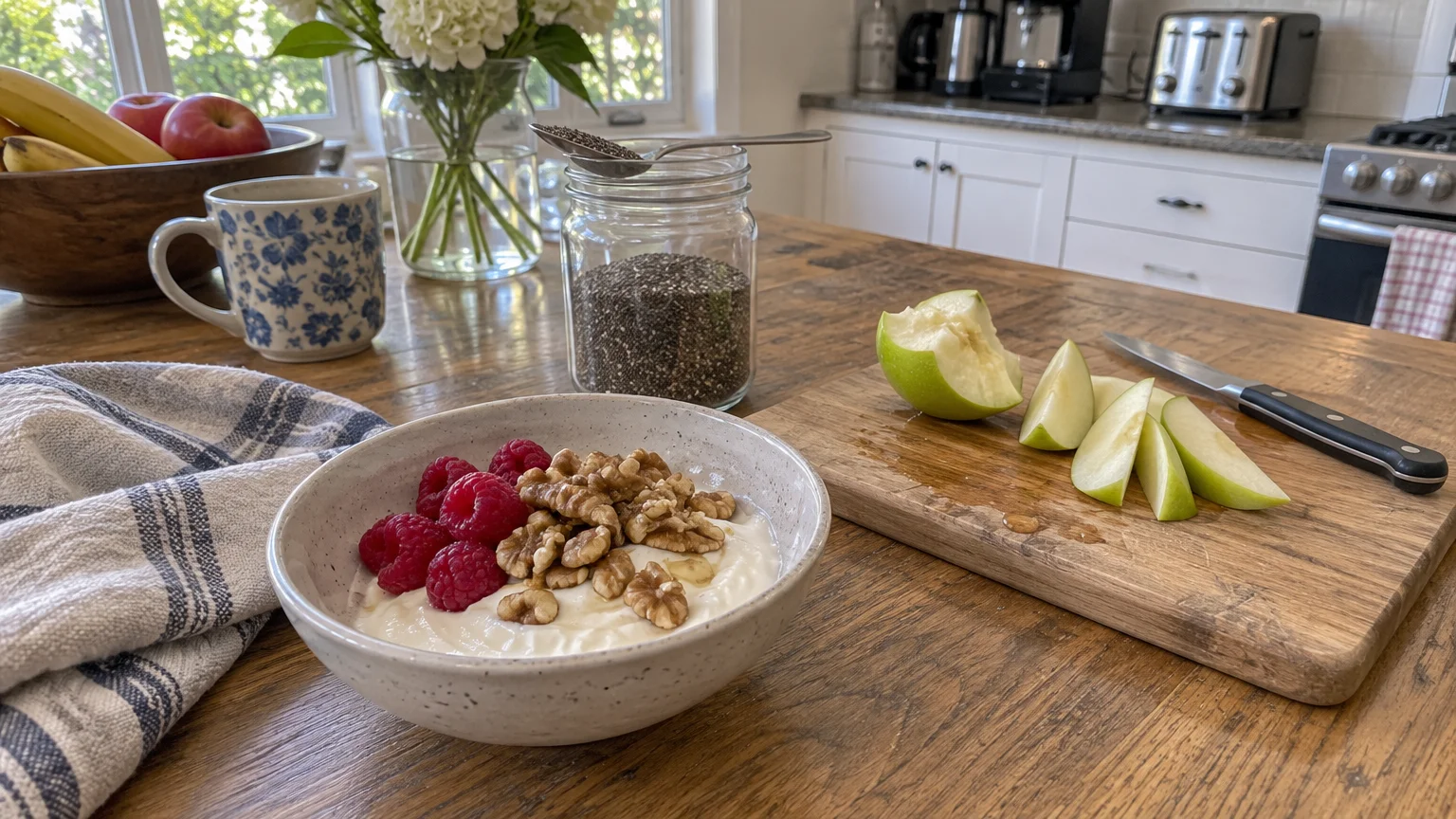
Pairing a small apple with two tablespoons of peanut butter or layering raspberries over unsweetened Greek yogurt blunts the post-meal glucose curve. Dietary fat and protein slow gastric emptying, keeping your energy steady.
Notice that avocados, berries, and citrus fruits earn recognition among top diabetes-friendly staple foods because they supply high fiber, potassium, and antioxidants alongside modest carbohydrates. Making these three groups your weekly default builds automatic glycemic protection into your routine.
Smart Grocery Label Checks and Daily Swaps
In the canned and frozen aisles, turn packages around before dropping them into your cart. Look for clear label wording stating packed in own juices, unsweetened, or no added sugar, and leave heavy-syrup cans on the shelf.
Check the nutrition facts panel for the added sugars line, which separates fruit’s intrinsic sugar from syrups added during processing. Even dried cranberries or tart cherries come in reduced-sugar or juice-sweetened versions that spare you unnecessary glucose surges.
At breakfast, swap a tall glass of orange juice for one small whole orange alongside scrambled eggs and sautéed spinach. During the afternoon slump, trade a handful of sweetened trail mix for one cup of fresh blackberries and a small handful of raw walnuts.
For dessert, freeze seedless grapes or blend frozen raspberries with plain kefir instead of scooping heavy-syrup canned peaches over ice cream. Small swaps repeated daily compound into measurable metabolic progress without leaving you feeling deprived.

The Lifestyle Layer: Movement, Sleep, Stress, and Support
Food choices never operate in isolation from how you move, rest, and manage daily pressure. Taking a brisk ten-to-fifteen-minute walk right after enjoying a sweeter fruit like mango or banana prompts working leg muscles to absorb glucose independently of insulin.
Even light household chores or stretching after dinner flattens post-meal blood sugar peaks significantly. Timing higher-carbohydrate fruit right before or right after physical activity puts natural sugar to immediate muscular use.
Sleep quality strongly dictates how smoothly you handle morning fruit. When you sleep poorly, elevated stress hormones make morning cells temporarily insulin resistant, causing oatmeal topped with raisins to spike glucose higher than it would after eight solid hours of rest.
Chronic work or family stress triggers similar cortisol waves that raise baseline blood sugar before you even take a bite. Simple breathing pauses, outdoor sunlight, and predictable meal spacing calm that hormonal noise.
Community support also makes healthy fruit habits easier to keep over the long haul. Splitting bulk trays of mangoes or melons with neighbors, sharing budget produce co-ops, or inviting family members to prep washed berries on Sunday turns nutritious eating into a shared routine.
Monitoring Biomarkers, Medication Interactions, and Safety
Personalized feedback beats guesswork every time you adjust carbohydrate sources. If you track blood sugar at home, check your reading right before eating a fruit-containing meal and again one to two hours after your first bite.
Comparing your pre-meal and post-meal numbers reveals which fruits fit your personal tolerance best. One person handles half a banana with minimal change, while another sees steadier readings with strawberries and avocado.
Ask your healthcare provider how your fruit routine aligns with routine lab markers like hemoglobin A1C, fasting glucose, and fasting triglycerides. Rising triglycerides alongside central weight gain can signal excess fructose from sweetened drinks, dried snacks, or oversized fruit portions.
Medication safety deserves careful attention whenever you shift carbohydrate habits. If you take insulin or sulfonylureas, cutting fruit portions abruptly without adjusting doses with your prescriber can trigger low blood sugar.
Conversely, certain blood pressure drugs, cholesterol-lowering statins, and transplant medications interact strongly with grapefruit and Seville oranges. Always ask your pharmacist or physician whether grapefruit fits safely alongside your current prescriptions.
Seek prompt medical evaluation if you experience warning signs such as repeated blood sugars above your target range, frequent urination, extreme thirst, blurred vision, dizziness, or unexplained weight loss.
Persistent symptoms of low blood sugar—like shakiness, sweating, or confusion—also require immediate guidance from your care team.
Frequently Asked Questions About Fruit and Blood Sugar
How can I include fruit wisely when dining out?
Scan restaurant menus for fresh berry cups, citrus segments, or side salads topped with avocado rather than pastries, fruit cobblers, or glazed dishes.
Ask servers to hold sweetened vinaigrettes or caramel drizzles on fruit salads, and pair any fresh fruit course with grilled protein or nuts to slow digestion.
What are the best budget-friendly low-sugar fruit options?
Unsweetened frozen strawberries, blackberries, and raspberries deliver the exact same vitamins and fiber as fresh berries at a fraction of the year-round cost, with zero spoilage waste. Whole seasonal oranges, grapefruits, and modest-sized apples also stretch grocery budgets while keeping natural sugar manageable.
Should I take fruit extract or fiber supplements instead of eating whole fruit?
Whole fruit outperforms isolated pills and powders because intact plant cells deliver water, potassium, fiber, and dozens of synergistic antioxidants together. Supplements rarely replicate that natural food matrix and are unnecessary unless your physician or registered dietitian recommends targeted fiber support for a diagnosed condition.
How do I adapt cultural dishes that rely on tropical or dried fruits?
You never need to abandon traditional flavors to care for your metabolism.
Keep mango salsa, tamarind chutneys, or date-sweetened grain dishes on the table by shrinking the dried or tropical fruit portion into a flavorful garnish and anchoring the rest of your plate with vegetables, legumes, and lean proteins.

Taking Your Next Step With Your Care Team
Understanding natural sugar in fruit removes the guesswork and fear from the produce aisle. When you prioritize fiber-rich berries, avocados, and citrus while measuring sweeter tropical and dried fruits mindfully, fruit becomes an ally for long-term health.
Bring your favorite fruit choices and any blood sugar logs to your next appointment with your doctor or registered dietitian so they can tailor targets to your lab results and medications.
Pick just one simple habit to track this week—such as swapping afternoon juice or dried snacks for one cup of fresh berries paired with nuts—and notice how steadily your energy holds.